
 By Micheal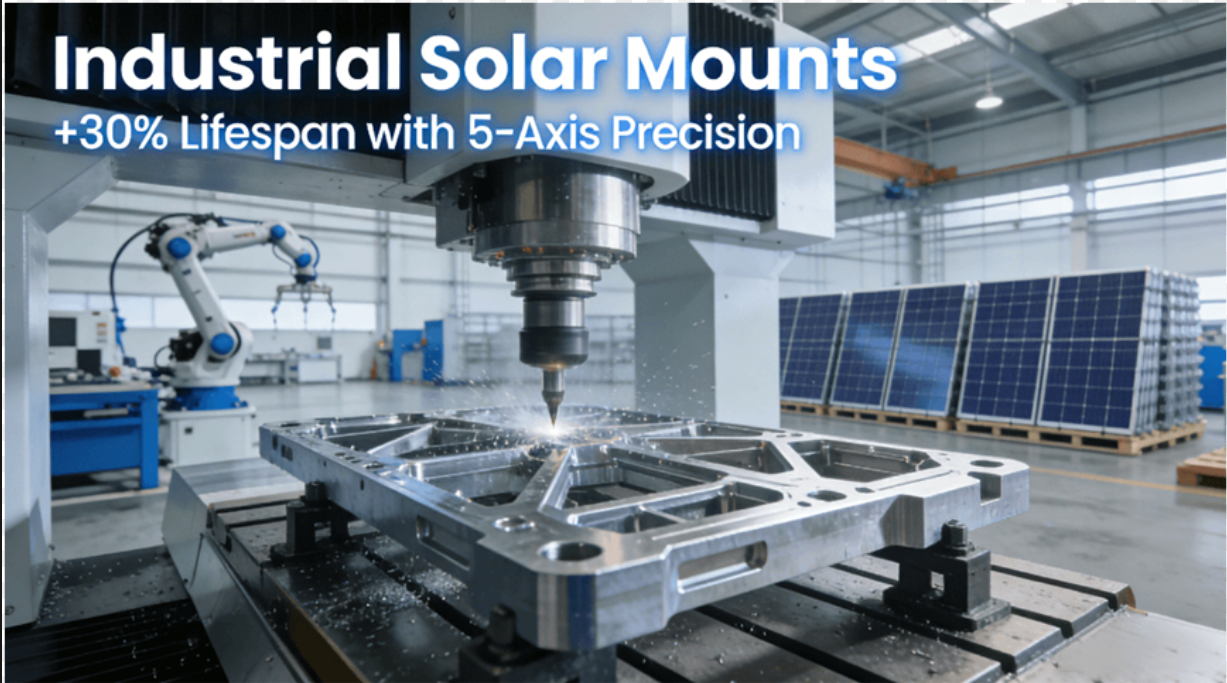
In the industrial solar sector, equipment like tracking systems, inverter housings, and generator components endure decades of harsh outdoor exposure. This places extreme demands on the precision, strength, and corrosion resistanceof structural parts. Traditional manufacturing or low-level automation often struggles with complex geometries, thin walls, and high-strength materials, leading to insufficient accuracy, stress concentrations, and poor fit. The result is decreased system efficiency, higher maintenance costs, and a compromised return on investment.
The root cause lies in manufacturing limitations. Multi-step, multi-fixture processesintroduce cumulative errors. When machining lightweight, high-strength materials like specialized aluminum alloys or stainless steel, conventional machines often fail to balance efficient material removal with the dimensional stability and surface integrityrequired for complex features like lightweight cavities and fluid channels. This article analyzes how automated 5-axis CNC machining centersprovide a transformative solution, delivering unmatched precision, consistency, and part longevity.
Why Does the Reliability of Industrial Solar Solutions Begin with Manufacturing Precision?
The performance and longevity of an industrial solar installation are directly built upon the geometric fidelity of its thousands of mechanical components. A solar tracker with a linkage machined to loose toleranceswill suffer from misalignment, binding, and accelerated wear, directly reducing energy harvest. Poorly sealed inverter enclosures due towarped flangesinvite moisture and dust, causing electrical failures.Precisionis not a luxury; it is the non-negotiable foundation for system-level reliability and efficiency over a 25+ year lifespan.
1. The Direct Link Between Part Quality and System Output
Research consistently correlates component quality with plant performance. Studies, such as those from the National Renewable Energy Laboratory (NREL), highlight how variations in structural accuracy contribute to system-level performance losses. In concentrated solar power (CSP) systems, for example, the precise alignment of reflector mounts and receiver assemblies is critical for maintaining optical efficiency. This makes Manufacturing Solar Integration — the seamless fusion of high-precision parts into a reliable system — a core engineering discipline, not just an assembly task.
2. The Role of Automation in Ensuring Consistency
For the solar industry, consistency at scaleis as important as capability. Automated machining solutions bring repeatable, data-driven precisionto the production of both high-volume and highly customized parts. Whether producing hundreds of identical mounting brackets or a single, complex receiver for a pilot project, automation ensures every part meets the same rigorous specification. This eliminates the performance variability that plagues manually intensive or less controlled processes.
3. Precision as the Cornerstone of Value
Therefore, investing in manufacturing precision is a strategic investment in the asset’s lifetime value. It reduces operational downtime, extends maintenance intervals, and protects the significant capital investment in the solar array itself. By ensuring that every component from the outset is manufactured to withstand environmental stresses and perform its function perfectly, Industrial Solar Solutionsproviders de-risk projects and enhance their financial viability, making precision the first and most critical step in the value chain.
How Does Automated 5-Axis Machining Overcome the Manufacturing Challenges of Complex Solar Components?
Solar energy systems are filled with components that defy simple machining: thin-walled, fluid-cooled central receivers; aerodynamically shaped torque tube connections; and structural nodes with compound angles. Automated 5-axis CNC machining conquers these by allowing the cutting tool to approach the workpiece from virtually any direction in a single, continuous setup. This eliminates the cumulative errors of multiple repositionings and enables the machining of deep cavities, undercuts, and complex contours that are impossible with 3-axis technology, unlocking designs that are both lighter and stronger.
1. Conquering Geometric Complexity in a Single Setup
The ability to machine five sides of a part in one clampingis revolutionary. For a solar tracker’s pivotal bearing housing, this means all critical bores, mounting faces, and seal grooves are machined in perfect relationship to one another. This guarantees the concentricity, perpendicularity, and positional accuracyneeded for smooth, low-friction rotation over decades. It transforms a complex assembly of parts into a single, high-integrity monolithic component, drastically improving reliability.
2. Enabling Lightweighting and Integrated Functionality
5-axis technology is key to designing for performance. It allows engineers to create organic, topology-optimized structuresthat remove material only where it isn’t needed, reducing weight and material cost without sacrificing strength. Furthermore, it enables the machining of internal cooling channelsdirectly into a CSP receiver body, improving thermal management and efficiency. This integration of form and function is where 5-axis machining delivers profound value beyond simple shape replication.
3. Leveraging Automation for Scalable Precision
To fully harness these geometric capabilities at production scale, automation is essential. A robotic cell integrated with 5-axis machining centers can manage raw material loading, part flipping (if required), and finished part unloading with minimal human intervention. This not only reduces labor costs but also ensures a consistent, unmanned process that runs 24/7, crucial for meeting the volume demands of global solar deployment. Implementing a strategy for automating 5 axis machiningis what bridges the gap between prototyping brilliance and production reality.
What is the True Cost-Benefit Analysis of Investing in a 5-Axis CNC Machine?
The upfront price tag of a 5-axis CNC machine is a legitimate concern, often cited as a barrier to adoption. However, a true assessment requires a holistic view of Total Cost of Ownership (TCO)and the value generated. A full TCO analysis must compare the capital expenditure, floor space, labor, and operational costs of multiple 3-axis machines and secondary processes against a single, automated 5-axis cell. The 5-axis solution typically wins by consolidating operations, slashing setup times, reducing scrap, and minimizing work-in-process inventory.
l Quantifying the Efficiency Dividend: Studies from leading research institutions validate the efficiency gains. Research on high-dynamic 5-axis machininghighlights its role in significantly improving Overall Equipment Effectiveness (OEE). For solar component manufacturing, this translates to: faster production cycles for complex parts, lower energy consumption per part, and the ability to tackle more valuable work. The “cost per precision feature”drops dramatically, making 5-axis machining economical for mid-volume production, not just prototypes.
l The Hidden Cost of Poor Quality: The most significant cost savings are often in avoided failures. A solar array in a remote location is astronomically expensive to repair. A component failure due to a machining defect or stress concentration can lead to massive revenue loss and warranty claims. The superior accuracy and surface integrityof 5-axis machined parts directly increase fatigue life and corrosion resistance, preventing these catastrophic costs. This quality dividendmust be factored into the ROI equation.
l The Strategic Partnership Alternative: Therefore, for many companies, the most rational path is not ownership, but partnership. Engaging a certified precision manufacturing service providerallows access to world-class 5-axis capability without the capital outlay, maintenance burden, and need for specialized programming talent. Partners operating under stringent IATF 16949 or AS9100Dframeworks bring a level of process control and traceability that ensures part quality, effectively transferring risk and allowing solar firms to focus on their core competency: system design and integration.
What Are the Best Practices for Designing 5-Axis CNC Parts for Solar Applications?
Even the most advanced 5-axis machine cannot compensate for a fundamentally unmanufacturable design. Success hinges on Design for Manufacturability (DFM) principlesapplied from the earliest concept stage. Key considerations for solar components include: standardizing internal corner radii to allow larger, stronger tools; optimizing wall thickness and aspect ratios to prevent tool vibration and distortion; and ensuring tool accessibility for all features by avoiding overhangs that create toolholder interference.
1. Designing for Stability and Tool Life
Solar mounts and structures are often large and thin-walled. DFM must prioritize designs that enhance machining stability. This means adding strategic stiffening ribs or gussetsto large flat areas prone to vibration. It also involves specifying generous draft angleson deep pockets to facilitate tool access and chip evacuation. These considerations prevent chatter, improve surface finish, and protect expensive cutting tools, directly lowering part cost.
2. Material and Specification Strategy
Consistency in design aids efficient production. Standardizing on a few high-performance, readily available aluminum or stainless steel gradessimplifies sourcing and allows the machinist to develop optimized parameters. Clearly defining critical vs. non-critical toleranceson drawings prevents the unnecessary cost of holding ultra-tight specs where they are not functionally required. A disciplined approach to material and tolerance specification is a major lever for cost control.
3. Engaging Expertise Early
The single most effective DFM practice is early collaboration with manufacturing experts. Before finalizing any design for a critical structural component, it is prudent to seek a professionalDFM analysis. Reputable providers of 5-axis CNC machining servicestypically offer this analysis during the quoting phase. Their engineers can identify potential manufacturing hurdles, suggest cost-saving modifications, and ensure your design is optimized for both performance and production efficiency, de-risking the entire project.
How Will Automation and Precision Manufacturing Empower the Future of Renewable Energy?
The next generation of solar technology — from floating PV and perovskite-silicon tandem cell trackers to higher-temperature CSP systems — will demand even more from their structural components. They will require lighter, stronger, and more geometrically complex parts capable of surviving in more challenging environments. The convergence of automated 5-axis machining, digital twins, adaptive process control, and in-line metrology will be essential to meet these demands efficiently and at scale.
1. Enabling Mass Customization and Supply Chain Resilience
The future is not just mass production, but mass customization. Automated, flexible manufacturing cells will allow for the economical production of site-specific or technology-specific components without traditional tooling costs. This digital thread from design to partenhances supply chain agility, allowing for rapid design iterations and local/regional manufacturing strategies. It transforms the manufacturing solar integrationparadigm from a rigid supply chain to a responsive, adaptive network.
2. The Imperative of Certified, Sustainable Manufacturing
As solar becomes a cornerstone of global infrastructure, the manufacturing base supporting it must embody the highest standards of quality and responsibility. Partners will be evaluated not just on capability, but on their systemic commitment to excellence and sustainability. Certifications like ISO 9001 (Quality), ISO 14001 (Environmental), and AS9100D (Aerospace-derived rigor)become critical indicators of a supplier’s maturity, reliability, and alignment with the long-term, high-stakes nature of renewable energy projects.
3. Precision as the Engine of Levelized Cost Reduction
Ultimately, advanced manufacturing is a key driver for reducing the Levelized Cost of Energy (LCOE). By producing components that are more reliable, longer-lasting, and more efficient, precision automation lowers operational and maintenance costs over the plant’s lifetime. It enables the complex, high-performance designs that push conversion efficiencieshigher. In this way, the automated machining center is not just a machine tool; it is a strategic asset in the global transition to sustainable energy, building the physical foundation for a cleaner grid.
Conclusion
Automated 5-axis CNC machining provides a comprehensive upgrade for industrial solar manufacturing, offering unmatched precision, the ability to process complex geometries, and single-setup efficiency. It transforms structural reliability, enables lightweight and high-performance designs, and improves production economics. This technology is far more than a fabrication method; it is a strategic enabler for innovation, long-term system durability, and the continued reduction in the cost of solar energy. Mastering its application is essential for any organization leading the charge in renewable energy infrastructure.
FAQs
Q: What is the core advantage of automated 5-axis machining over traditional 3-axis for solar equipment?
A:The core advantage is single-setup machining of complex parts, which eliminates cumulative positioning errors. This ensures extreme geometric and positional accuracy for critical components like tracker linkages, guaranteeing long-term alignment, reduced wear, and optimal energy harvesting efficiency over decades of operation.
Q: For a solar startup, is it better to buy a 5-axis machine or outsource?
A:For most, outsourcing is more cost-effective and lower-risk. A professional service provider amortizes the high capital, maintenance, and expertise costs of 5-axis technology. This allows startups to access best-in-class capabilitywithout major investment, freeing capital and focus for core design, system integration, and business growth.
Q: What supplier credentials should I prioritize for 5-axis machining services?
A:Beyond ISO 9001, prioritize ISO 14001 (Environmental Management)and stringent process-based certifications like IATF 16949 or AS9100D. These indicate a systemic, preventative approach to quality with rigorous controls, traceability, and continuous improvement — essential for the reliability demands of solar infrastructure.
Q: How do I know if my solar part design is suitable for 5-axis machining?
A:If your design has deep pockets, compound curves, angled features, or requires precision on multiple non-parallel faces, it is an excellent candidate. The most reliable method is to submit your 3D model for a complimentary DFM analysiswith a qualified machining service. They can identify optimizations and confirm suitability.
Q: Will using 5-axis machining increase my product lead time?
A:Typically, it reduces total lead time for complex components. By consolidating multiple operations into one setup and utilizing automated production workflows, 5-axis machining often delivers parts faster than multi-step, multi-machine traditional processes, from prototype through to batch production.
Author Bio
This article is based on the technical insights of manufacturing and renewable energy specialists. The analysis connects advanced production methodologies with the real-world performance demands of next-generation solar infrastructure. CNC Protolabsis a certified manufacturing solutions provider that combines automated 5-axis machining expertise with a commitment to quality and sustainability, supporting innovators across the renewable energy sector.